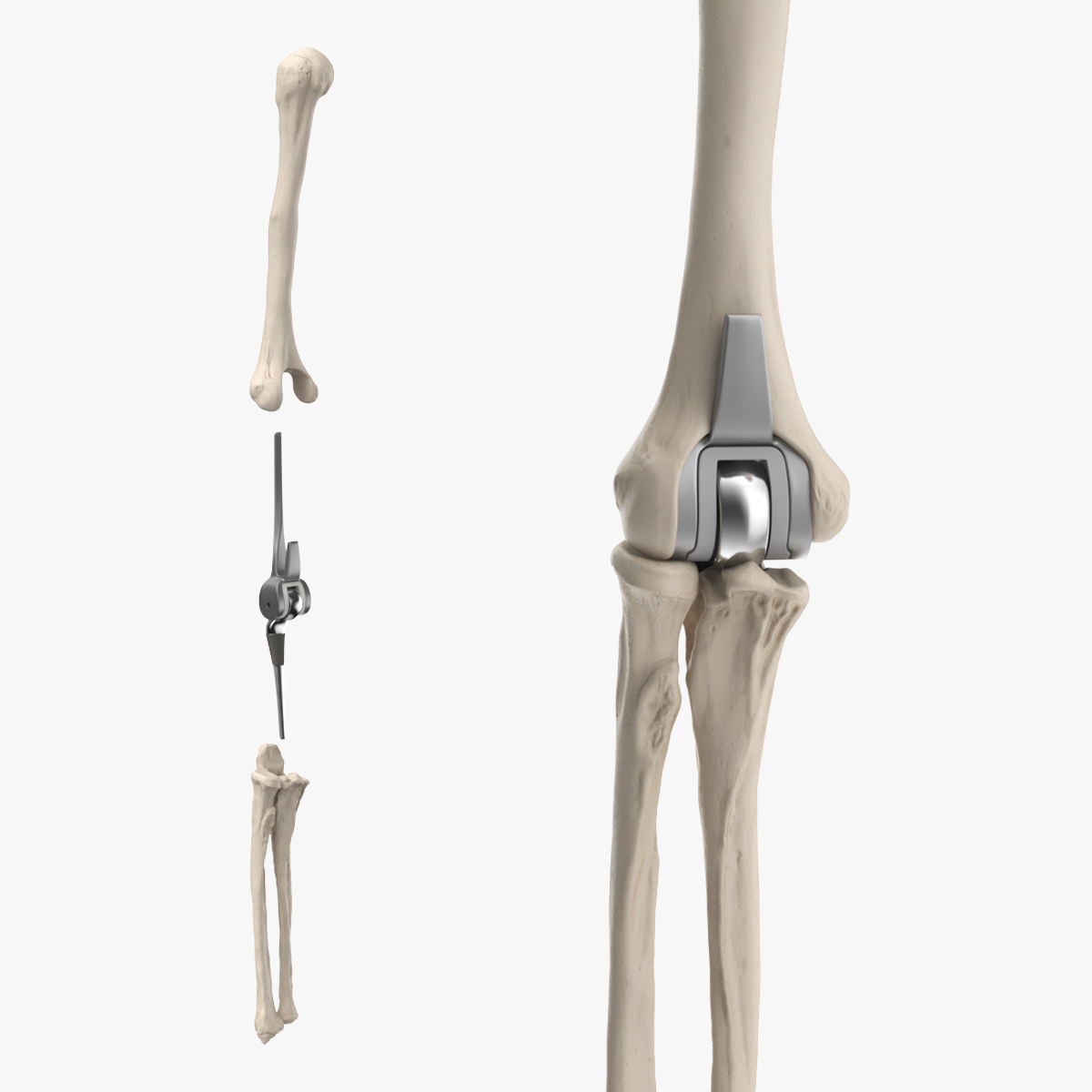
Elbow Joint Implant with Humerus and Ulna
An elbow joint implant fitted between the humerus and ulna, the hinge prosthesis surgeons use to replace a damaged elbow. Metal stems run into both bones, and a hinge links them so the arm can bend in a natural arc. The model uses just 6,144 polygons and 5,990 vertices, light enough for patient apps and web viewers.
Overall it measures 9.04 x 6.42 x H96.54 cm along the long axis of the upper and lower arm bones. Mixed UVs mean some parts share map space, so plan separate colors for bone and implant. The bones and prosthesis are separate, CheckMate-specification objects that can be hidden one at a time.
Brought to market in 2026, the model serves orthopedic education, surgical planning talks and implant manufacturer presentations. Fading the bone to transparent shows exactly how far each stem reaches inside the arm. Physiotherapists also use such visuals to explain recovery and safe movement after elbow replacement surgery.
Questions About This Model
What should I search for to find models like the Elbow Joint Implant with Humerus and Ulna?
Useful search terms are elbow, joint and implant. Browsing the Medical category shows the closest alternatives at a range of prices.
Which industries use the Elbow Joint Implant with Humerus and Ulna model?
Medical and Simulation are the primary industries on this listing, though the Royalty Free license puts no limit on where the model is actually used.
How heavy is the Elbow Joint Implant with Humerus and Ulna mesh?
6,144 polygons and 5,990 vertices, built as polygonal quads/tris. 6,144 polygons reads as economical next to the roughly 17,000 median of our Medical range.
How clean is the geometry on the Elbow Joint Implant with Humerus and Ulna model?
Geometry is modelled at true scale with a tidy edge flow, and the scene is split into named objects so partial reuse and material swaps stay simple.