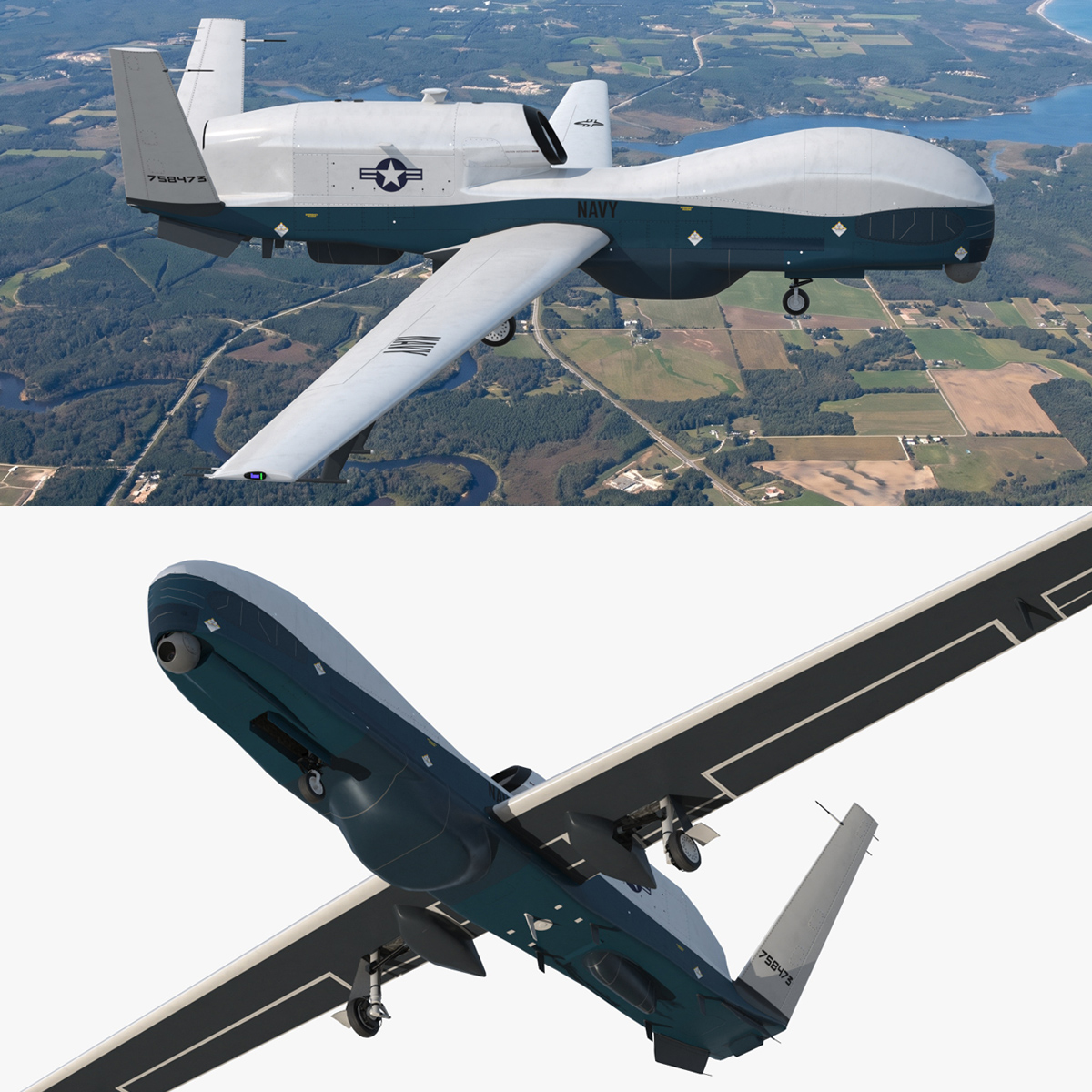
The Northrop Grumman MQ-4C Triton, a high-altitude maritime surveillance drone with long slender wings and a bulbous nose. It uses 121,861 polygons and 133,566 vertices, covering the sensor fairing, the V-tail and the engine intake. Its enormous wingspan and windowless nose make it read instantly as an unmanned spy aircraft, even at a distance.
Clean UV islands without overlap allow navy markings, tail numbers or a matte gray finish. Its StemCell pedigree keeps materials identical across every supplied format, saving conversion time in a pipeline. Seen from below against high clouds, the drone conveys long patrols over open ocean and remote coastlines.
Nine versions are listed, with Triton and Long-range Reconnaissance UAV rigs for Cinema 4D, Maya and generic use at $99. Static editions include the Long-range Reconnaissance UAV and a Triton Game Ready build, both at $79. Introduced in 2024, the drone already counts 17 buyers, and the branded editions are offered for editorial use.
Questions About This Model
Does the Northrop Grumman MQ-4C Triton model include materials and textures?
The product page states what ships with each format. StemCell delivery means a PBR material set that reads the same across renderers. See the listing for the exact contents.
How heavy is the Northrop Grumman MQ-4C Triton mesh?
121,861 polygons and 133,566 vertices, built as polygonal quads/tris. 121,861 polygons reads as economical next to the roughly 200,000 median of our Aircraft range.
Can the Northrop Grumman MQ-4C Triton model be used in a commercial project?
No. The model depicts a real branded product, so TurboSquid lists it under the Editorial Uses Only license. It may be used in news, commentary, education, personal projects and similar editorial contexts, but not in advertising, on merchandise or in any product offered for sale. See our license guide.
Which industries use the Northrop Grumman MQ-4C Triton model?
Aerospace, Simulation, Military & Defense and Film & Video Production are the primary industries on this listing. The license, however, is Editorial Uses Only: the model depicts a real branded product, so it may appear in editorial work in those fields, but not in advertising or in products for sale.