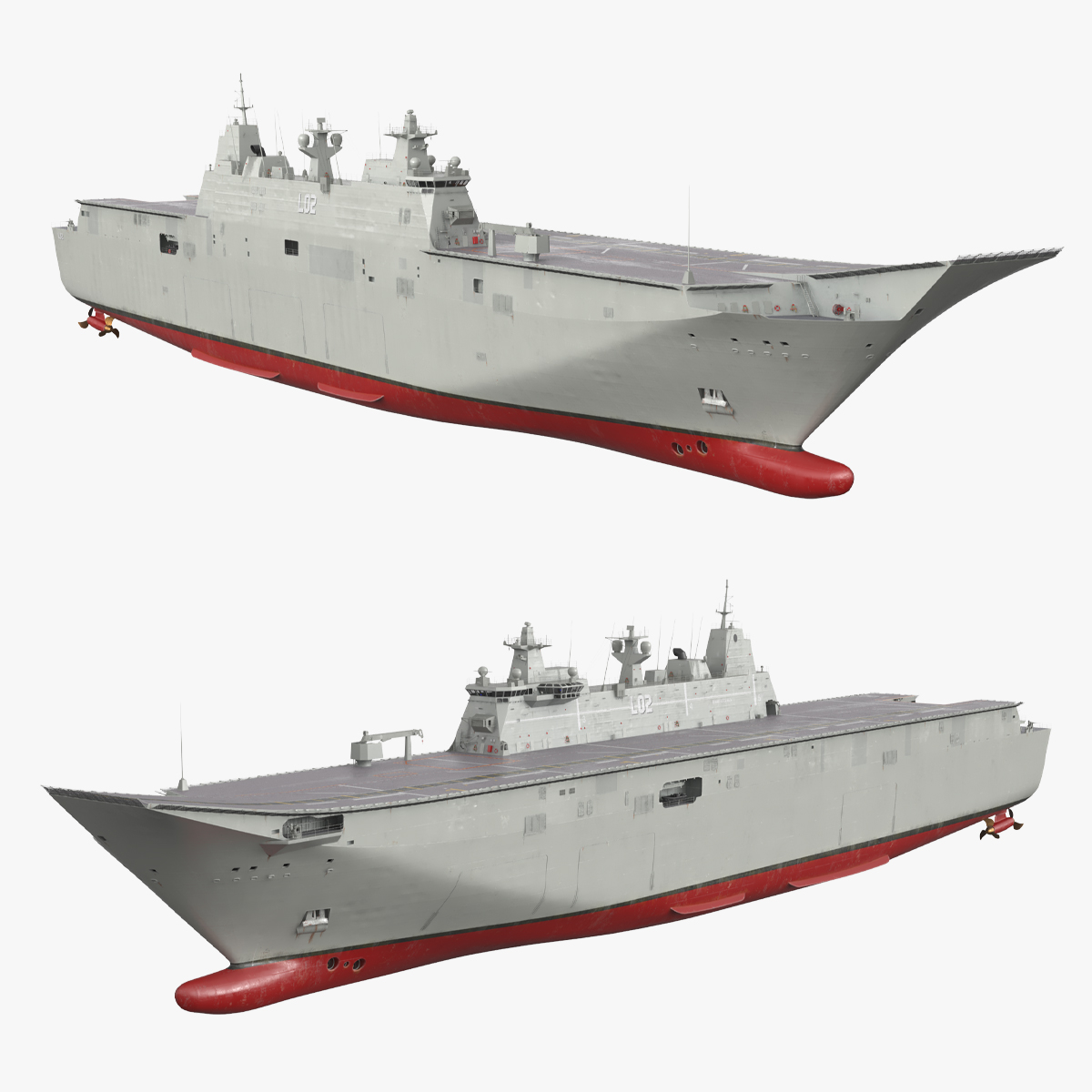
A US Navy amphibious transport dock with a stern well deck, an aft flight deck and angular enclosed masts. San Antonio Class Amphibious Transport Dock carries 465,170 polygons and 527,577 vertices across the superstructure, hangar and deck fittings. The faceted stealthy masts set the class apart from older amphibious ships even in a distant silhouette.
The UVs are unique with no overlaps, so hull numbers and weathering can be painted precisely. Under CheckMate Pro rules the hierarchy is clean and the scale is real, so helicopters and landing craft fit aboard.
Nine versions range from $229 for USS Portland to $439 for rigged packages with a Sikorsky helicopter on deck. The helicopter builds run 54% to 61% heavier, while USS Mesa Verde and USS Portland add about 7% to the hull detail. Rigged versions start at $289, and the named ships fall under Editorial Uses Only terms, unlike the Royalty Free plain variants. Available since 2020, the ship suits naval simulators, defense training and military documentaries.
Questions About This Model
Can the San Antonio Class Amphibious Transport Dock model be modified after purchase?
Yes. The Royalty Free license allows editing the geometry, retopologising, changing materials and adapting the asset to a project. What it does not allow is reselling or redistributing the model file itself.
Does the San Antonio Class Amphibious Transport Dock model include materials and textures?
The product page states what ships with each format. Textures, when present, come inside the download rather than as a separate purchase. See the listing for the exact contents.
Which industries use the San Antonio Class Amphibious Transport Dock model?
Military & Defense, Simulation, Film & Video Production and Advertising are the primary industries on this listing, though the Royalty Free license puts no limit on where the model is actually used.
How clean is the geometry on the San Antonio Class Amphibious Transport Dock model?
Geometry is modelled at true scale with a tidy edge flow, and the scene is split into named objects so partial reuse and material swaps stay simple.