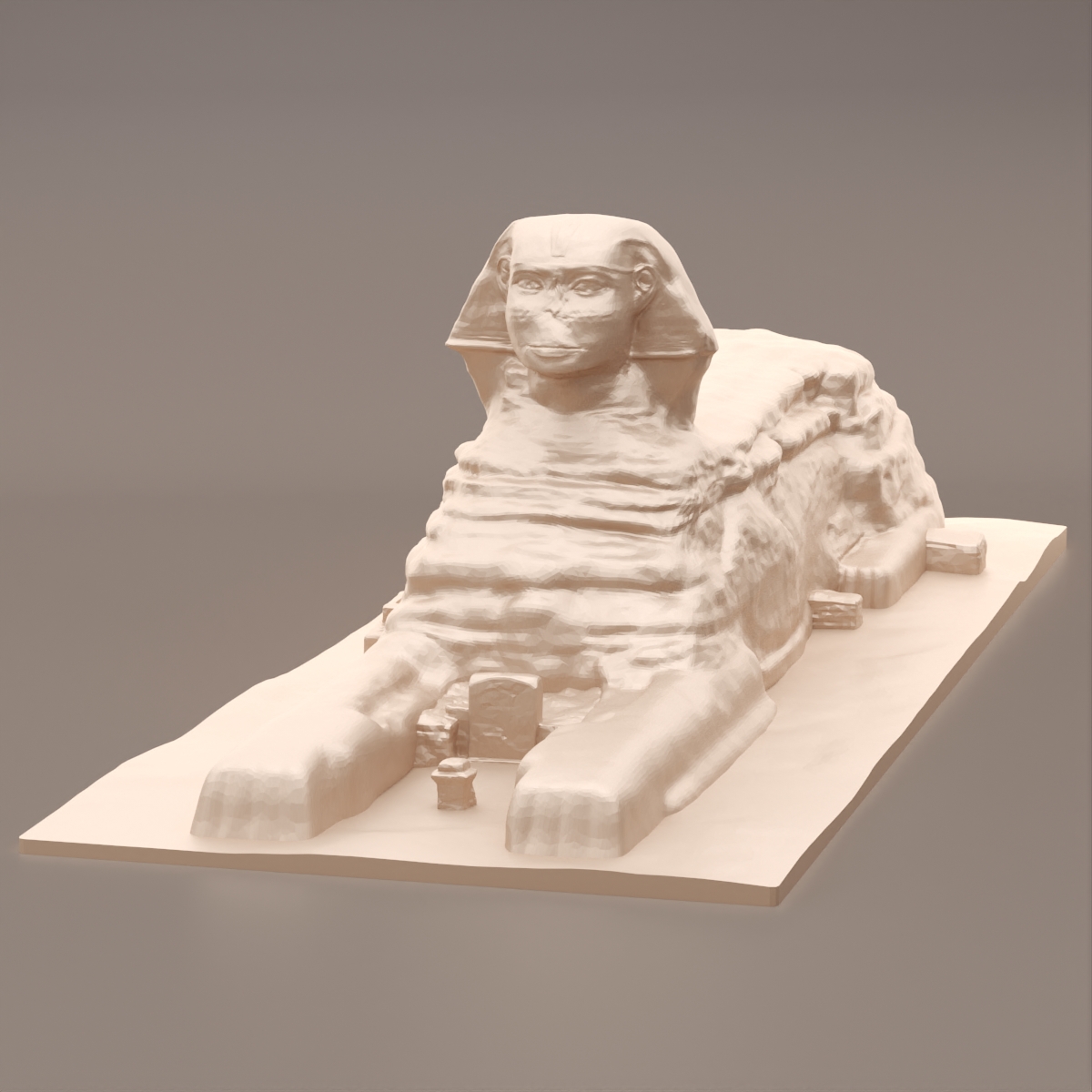
The limestone monument on the Giza plateau, modeled with its weathered headdress, broken face and outstretched paws. Its 97,366 polygons and 98,408 vertices describe sculpted erosion along the flanks and the stone enclosure around the body. Under a low sun, the layered bands of rock throw shadows that sell the scale of the statue.
Nine maps at 8192 x 8192 and 4096 x 4096 render the limestone tone, sand drifts and dark staining. Such resolution holds detail in close shots of the face and in wide aerial views alike. UVs do not overlap, and the StemCell format keeps scale and materials consistent between applications.
Offered as one complete piece without variants, it has served documentaries, museum displays, history lessons and travel presentations since 2015. Film and television productions set in ancient Egypt also use it, as do games built around desert ruins. Pair it with distant pyramids and a dusty sky for a convincing establishing shot.
Questions About This Model
What is the Great Sphinx of Giza model typically used for?
Stated applications are architectural visualization, film & TV VFX and product rendering. Because the asset is finished rather than a base mesh, it also holds up as set dressing in scenes it was not specifically built for.
Which industries use the Great Sphinx of Giza model?
Architecture, Film & Video Production and Advertising are the primary industries on this listing, though the Royalty Free license puts no limit on where the model is actually used.
Where can I buy the Great Sphinx of Giza 3D model?
It is sold through TurboSquid, where this listing has been available since 2015. Purchase, download and licensing are handled by TurboSquid; delivery is immediate after checkout.
What does StemCell mean for the Great Sphinx of Giza model?
It means one source asset, several delivered formats, and a PBR material setup designed to read consistently across them - no rebuilding shaders after import.